Facebook Ads in Nepal: Running Meta Campaigns That Produce Customers, Not Just Reach

Key takeaways
- Boosting a post is not advertising. It is a reduced interface that pushes toward engagement delivery, and engagement is the cheapest signal on the platform and the least connected to revenue.
- The campaign objective is an instruction, not a label. Meta finds people likely to produce the outcome you named, so naming the wrong one produces a campaign that works perfectly and sells nothing.
- A national audience in Nepal is small enough that narrow interest stacking exhausts quickly. Frequency climbs and creative fatigues early, so target broader and rotate more creative.
- Meta lead ads are available in Nepal while Google lead form assets are not, and Meta places no restriction on Nepali-language creative while Google does not support Nepali for ad targeting.
- Cash on delivery and WhatsApp conversations break the loop the same way: they report an outcome not yet confirmed as revenue, and the algorithm learns from whatever you report.
The short answer
Facebook and Instagram ads work in Nepal, and most Nepali businesses running them are buying the wrong thing. The spend goes through the Boost button on a Page post rather than a campaign built in Ads Manager, and boosting pushes toward engagement delivery. Engagement is the cheapest signal Meta sells: there is a near-unlimited supply of people who react to posts and never buy anything, and a system told to find engagement will find them cheaply for as long as you fund it.
The fix is structural. Build the campaign in Ads Manager, name a business outcome as the objective, report a real conversion event back to Meta from your own systems, keep targeting broader than instinct suggests because a country-sized audience in Nepal is small, and refresh creative on a schedule because frequency climbs fast here. Then judge the account on customers closed.
The one-line test
Ask what your last campaign told Meta to go and find. If the answer is "people who will engage with this post", the campaign is working correctly and the objective is wrong. Nothing downstream can fix an instruction to buy the wrong outcome.
Why boosting is not advertising
A Meta campaign has three layers. The campaign holds the objective. The ad set holds the audience, the budget and the optimization event — the specific action Meta hunts for. The ad holds the creative. Boosting collapses all three into one screen and strips out most of the middle layer, leaving no real control over the optimization event, which is the most consequential setting in the system.
That matters because Meta is not showing your ad to your audience. It shows it to the subset most likely to perform the action it was told to optimize for. Tell it to find engagement and it serves habitual engagers, who are cheap to reach because everyone bidding for them is bidding on a low-value action.
So cheap engagement is the most expensive thing you can buy. It is not merely wasted spend — it trains the account. The pixel and the delivery model build a picture of your customer from people who react to content, and that picture influences later campaigns. Six months of boosting leaves an account taught the wrong answer.

One honest defense: boosting is fine for amplifying content to an audience you already have. The failure is using it as the acquisition mechanism and evaluating it as one.
The objective is the instruction
Once you accept that Meta finds people likely to do the thing you named, objective selection stops being an administrative step. Read the second column below as literally as it is written, because the system does.
| Objective | What Meta optimizes for | When it is right | What to measure |
|---|---|---|---|
| Awareness | Cheap reach across the broadest set | A launch, or filling a retargeting pool first | Branded search and direct traffic |
| Traffic | People likely to click, not to act | Almost never as a primary campaign | Whether the sessions do anything |
| Engagement | People likely to react, share or message | Events, and click-to-message when replies are staffed | Reply and conversation-to-customer rate |
| Leads | People likely to submit a form | Services, consultancies, real estate, education | Qualified leads and close rate |
| Sales | People likely to fire the purchase event you report | E-commerce, or any transaction you can report | Confirmed orders, not orders placed |
After Engagement, the row that causes most damage is Traffic. It looks like the sensible middle option, but it instructs Meta to find clickers, and clicking is a behavior with its own frequent practitioners. If you want people on the site to do something, name the something. And a Leads or Sales objective only works if something reports leads or sales back.
The pixel, the Conversions API, and buying on faith
A Meta pixel is code in the visitor browser that reports what happened after the click. That is no longer sufficient anywhere: privacy restrictions, tracking prevention, blockers and limits on cross-site identifiers have eroded what a browser tag can observe, so a meaningful share of real conversions now go unattributed.
Meta's answer is the Conversions API — a server-side path where your own systems report the event directly. It matters for one reason: the event comes from a system you control, so it can carry outcomes the browser never saw, such as an order confirmed by phone the next day.
I am keeping this conceptual, because setup specifics change while the concept decides whether the setup is worth doing. The discipline of proving a signal before trusting it is in the conversion tracking guide — verify that every event fires once, for a real action, and matches your own records before an algorithm optimizes against it.
The prerequisite nobody wants to hear
A business that cannot say which ad produced a specific sale is not managing Meta ads. It is buying them on faith and reading the platform report as scripture. Fixing that is unglamorous and worth more than any targeting change you will make this year.
Audience strategy when the whole country is a small audience
This is where advice written for larger markets stops transferring. Meta reported a Facebook advertising reach of roughly 14.8 million in Nepal against a population of about 29.6 million, with Instagram far smaller at 4.35 million (DataReportal, Digital 2026: Nepal, October 2025) — platform-reported reach estimates, not counts of unique people.
Now do the arithmetic. A Kathmandu furniture retailer targeting Nepal, ages 25 to 45, interested in home decor, excluding existing customers, is addressing a slice of a slice — one that can be run through in days.
What happens next is mechanical. When the audience is exhausted Meta does not stop; it shows the same ads to the same people again. Frequency climbs, response falls, cost per result rises, and the account looks like it is degrading mysteriously. You ran out of people. The counterintuitive fix is to target more broadly.
- Start broad. Country or major-city geography, a wide age band, and let the conversion signal do the narrowing.
- Treat frequency as a first-class metric. Rising frequency with a falling result rate is exhaustion, and no bid change fixes that.
- Keep more creative in rotation than feels necessary — new creative re-opens an audience the old creative used up.
- Exclude recent purchasers and current customers, then stop.
Creative for the Nepali feed
The general methodology is out of scope — the one-variable-at-a-time approach is in the Meta creative testing framework and applies unchanged. What follows is what is different about this audience.
Language, and an asymmetry worth stating
Nepali feeds are multilingual in a way that is normal here and unusual elsewhere. English, Devanagari-script Nepali and Romanized Nepali all appear, often within one sentence. Premium categories often read better in English; everyday retail, food and local services land harder in Nepali, because that is the register a friend would use.
Here is the asymmetry almost nobody states: Meta does not restrict Nepali-language creative, and Google effectively does. Nepali does not appear in Google's list of languages available for ad targeting — which includes Hindi, Bengali, Urdu and Tamil — and Google states that ads created in an unsupported targeting language will be disapproved. That is a Google constraint, not a platform-wide one.
What actually stops a scroll here
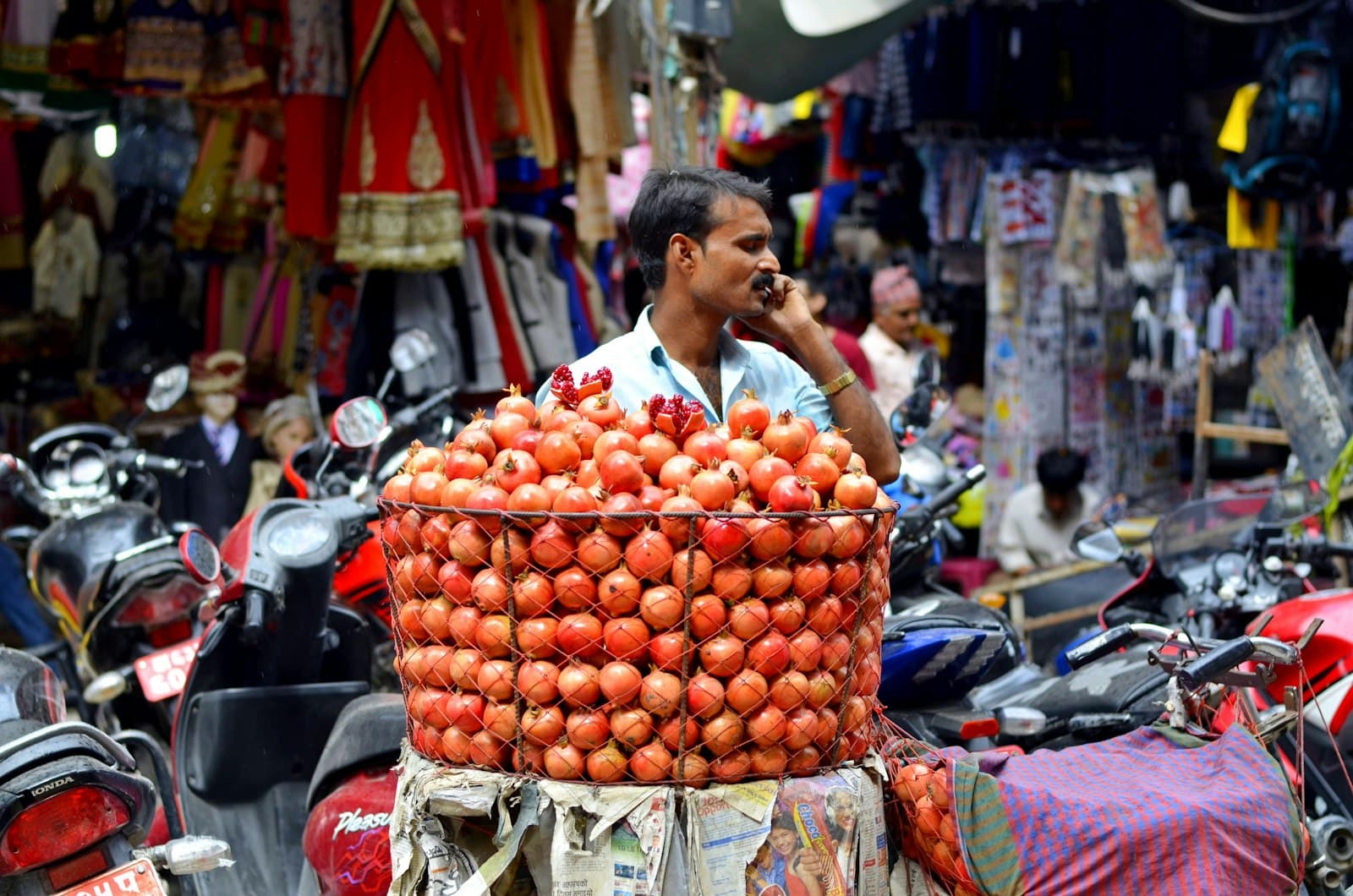
Recognizable local context outperforms generic stock imagery by enough to justify shooting your own — a real shopfront, a real street, a person who looks like the customer. Price transparency qualifies traffic before the click, in a market where "inbox for price" is the default and is treated with suspicion.
Format is not optional. Mobile is roughly 62% of device traffic in Nepal (StatCounter, June 2026), so vertical, sound-off-legible creative is the baseline rather than an optimization. A horizontal asset repurposed from desktop arrives cropped, muted and unreadable.
Lead ads versus landing pages in Nepal
Meta lead ads open a form inside the app, pre-filled with what Meta already knows. No page load, no typing, no connection dependency. Google lead form assets are unavailable here — Nepal is absent from Google's published eligibility list while Bangladesh, India, Pakistan and Sri Lanka are on it — so this is a capability Meta has in Nepal and Google does not.
It is also a trap if you take the volume at face value. Removing friction removes it for everyone, including people who tapped out of curiosity and will not remember doing so when you call. Lead ads produce more leads, at a lower cost per lead, at a lower average intent — all three flattering the report.
So qualification moves downstream, and that is the actual work. Across the accounts I have run — several countries and industries, mostly not Nepal — lead-to-customer close rates have sat around 12% in a typical niche and around 8% for consultancy work. Those are close rates on generated leads, not ad conversion rates, and they are cross-market figures rather than Nepali benchmarks. Two campaigns with identical lead counts at identical cost can produce completely different revenue.
- Choose the higher-intent form option over the fastest one when quality matters more than volume.
- Add a qualifying question a casual tapper will not answer. The drop-off is the filter working.
- Respond in minutes. An in-app lead is the least committed you will receive, and its value decays fastest.
WhatsApp and Messenger as the conversion destination
Click-to-message campaigns send the person into a WhatsApp or Messenger conversation instead of to a form. In Nepal these frequently outperform both, for behavioral reasons: messaging is where people already are, and a conversation feels lower-commitment than handing details to a stranger. What breaks is never the ad.
- Nobody answers. The most damaging failure — a message left unread for a day is worse than an unfilled form, because the person made an effort and was ignored. If you cannot staff replies during the hours you advertise, do not run message campaigns then.
- No record exists. The conversation lives in one phone, in one inbox, belonging to one person — not searchable, not reportable, gone when that person leaves.
- No attribution survives. Meta can report that a conversation started, not that it became a customer three days later — so you optimize toward conversations, and conversations are not revenue.
All three are process problems, and they compound as soon as the ads work. The design that prevents them is in the post on building a lead routing system that does not drop leads, and it should exist before the first click-to-message campaign launches.
Cash on delivery and the optimization loop
Cash on delivery is a normal and expected payment method for online orders in Nepal, and it changes what a purchase means inside a Meta account. Someone places an order, the site fires a purchase event, and Meta records a conversion and updates its model of who buys from you. But no money has moved, and some of those orders will be refused.
That is worse than over-counting. If the people most likely to place an unconfirmed order and the people most likely to actually pay are different groups — and there is no reason to assume they are the same — then optimizing toward order placement selects for the wrong customers. The account looks like it is scaling, and the bank balance disagrees.
The correction is simple to state and annoying to operate: optimize toward the confirmed outcome rather than the placed one. Report the order confirmed by phone, or delivered and paid, as the event Meta learns from. Fewer, truer events beat abundant false ones.
One boundary I will hold: which payment method a Nepali business should use is not something I will rank. Digital wallets and bank transfer are both common alongside cash on delivery, and terms change often enough that you should compare providers yourself.
Paying for Meta ads from Nepal
Foreign digital advertising spend is treated in Nepal as an import of services, subject to annual foreign-currency limits that are low relative to what a committed advertiser would want to spend — and the ceiling applies to your total, not per platform, so Meta alongside Google does not give you a second allowance. The treatment is covered in the guide to running Google Ads from Nepal — the same constraints apply to Meta, and specific limits should come from your own bank and a Nepali chartered accountant rather than from any article.
The metric that lies
The flattering metrics here are reach, engagement and cost per thousand impressions, and they lie convincingly: they improve while the business gets nothing. Reach rises because reach is what a small, engagement-friendly audience will happily give you. Engagement rises because you are buying engagers. And cost per thousand impressions can fall as delivery finds cheaper people — which reads as efficiency and is actually the account drifting toward the least valuable attention available.
Impressions up, cost per thousand impressions down, engagement up, sales flat. That is the state most long-running boosted-post accounts are in, and it survives because the report never says anything is wrong.
The second number that catches it
Put closed customers per month, from your own records, next to platform-reported results over the same period. If platform results climb while closed customers stay flat, the account is buying cheaper attention rather than more business — and a falling cost per thousand impressions is the confirming symptom.
Where this breaks in practice
- The objective was chosen once and never revisited. Someone selected Engagement two years ago and every campaign since has been duplicated from it.
- Everything runs from one ad set with one creative, so the account learns nothing and fatigues all at once.
- The pixel fires on page load rather than on the action, so every visitor counts as a conversion and the numbers look extraordinary.
- Retargeting runs before there is anyone to retarget, and the budget goes somewhere you did not intend.
- The ads work and the business cannot absorb the volume — and the honest conclusion, that the constraint is operational, never gets drawn.
A starting sequence
The order I would work in for a Nepali business moving from boosting to real campaigns. It front-loads the unglamorous parts, because those decide what is measurable later.
- Define one conversion action that represents a real business outcome — a qualified enquiry, a confirmed order, a booked appointment. One, not seven.
- Decide how that outcome gets recorded outside Meta. If it exists only in the dashboard, you cannot check the platform against anything.
- Report the signal from your own systems, and verify each event is real before spending against it.
- Fix the destination — a landing page fast on mobile, or a message flow with a named person answering. Whichever you cannot staff, do not run.
- Build one campaign in Ads Manager with a Leads or Sales objective. Broad geography, wide age band, minimal interest layering.
- Ship three to five genuinely different creatives, vertical and sound-off-legible, in the language register your category responds to.
- Set the review cadence in writing before launch, then leave it alone long enough to accumulate signal.
- Read frequency alongside result rate. Rising frequency with falling results means new creative, not new bids.
- Reconcile against your own records monthly and compute close rate by campaign. This turns an advertising question into a business answer.
- Only then add retargeting or a second platform, funded by a written reason rather than a quoted percentage.
The honest scope of this post
This post does not tell you what a click or a lead costs on Meta in Nepal, because no credible published dataset exists and I will not invent one. It does not claim my own numbers are Nepali numbers — I have managed over USD 50,000 on Meta across several countries, largely outside Nepal. And it does not settle whether Meta or Google is right for you, which is answered in the comparison of Google Ads and Facebook Ads in Nepal.
What it does do is describe the mechanics that are knowable and decisive, and those do not expire the way a cost table would.
Where to go from here
Open Ads Manager and look at the objective on your current campaigns before changing anything else. If it says Engagement or Traffic, you have found the problem, and no creative or targeting work will out-run it.
I run Meta and Google accounts for clients through Arcetis, the growth and automation practice I founded in Pokhara. The pattern that holds across every account is the one this post opened with: the platform is doing exactly what it was told, and nobody checks what they told it.
Frequently asked questions
Is boosting a post the same as running a Facebook ad?
No. Boosting builds an ad from an existing post through a reduced interface that hides the campaign structure, most audience controls and the optimization event. It defaults toward engagement delivery, so Meta looks for people likely to react, comment or share. A campaign built in Ads Manager lets you name a business outcome instead, and the system hunts for people likely to produce it.
Why do my boosted posts get likes and comments but no sales?
Because that is what you asked for. Engagement-optimized delivery finds the people most likely to interact with a post, and habitual engagers are a real behavioral group who are not disproportionately buyers. The campaign is not failing — it is succeeding at the wrong objective. Rebuild it in Ads Manager with a sales or leads objective and report a real conversion event back.
Can I run Facebook ads in the Nepali language?
Yes. Meta places no restriction on Nepali-language ad copy, including Devanagari script and Romanized Nepali, and creative mixing English and Nepali is normal here. This differs from Google Ads, where Nepali does not appear in the list of languages available for ad targeting and Google states that ads written in an unsupported targeting language will be disapproved. For local-language creative, Meta is less constrained.
Do Meta lead ads work in Nepal?
Yes. Meta lead ads run in Nepal, which matters because Google lead form assets do not — Google publishes a country eligibility list for that format and Nepal is absent while Bangladesh, India, Pakistan and Sri Lanka are present. In-ad lead capture is available on Meta and unavailable on Google here. The trade-off is that in-app forms remove so much friction that average intent falls.
Should Facebook ads in Nepal send people to WhatsApp or to a landing page?
It depends on whether anyone is available to reply. Click-to-message campaigns often outperform forms in Nepal because a conversation feels lower-commitment and messaging is where people already are. But an unanswered message is worse than an unfilled form, because the person made an effort and got nothing. If replies happen within minutes during advertised hours and are logged durably, messaging wins.
Does cash on delivery break Facebook ads tracking?
It breaks the meaning of the tracking rather than the mechanism. The purchase event fires when the order is placed, but no money has moved and a share of those orders will be refused at the door. Meta then optimizes toward people who place orders rather than people who pay, and there is no reason to assume those are the same group. Report the confirmed order instead.
What do I need in place before spending anything on Meta ads in Nepal?
One defined conversion action representing a real business outcome, a durable record of where each enquiry came from, a named person responsible for responding, and a destination that works on a mobile connection. Mobile is the dominant device for web traffic in Nepal, so a page that only behaves well on desktop is effectively broken. Without those four, spend produces activity you cannot evaluate.
Are Facebook ads cheaper than Google Ads in Nepal?
Nobody credibly knows, and any article quoting a Nepal cost-per-click comparison is quoting a number with no traceable source. No methodologically documented cost dataset exists for either platform in this market. Cost per click is also the wrong comparison, because the two platforms sell different things — declared intent versus attention. The only comparison that survives scrutiny is cost per closed customer.
Book a free 10-minute call about your Meta account
If you are running Meta ads from Nepal and cannot say which ad produced a paying customer, bring the account and we will find where the signal breaks. If the honest answer is that your setup is fine and the problem is the offer, that is what I will tell you.
Direct: +977 9846162626 · lamichhanesapun2@gmail.com
This post supports the frameworks documented in full on the Authority page.
Related reading